
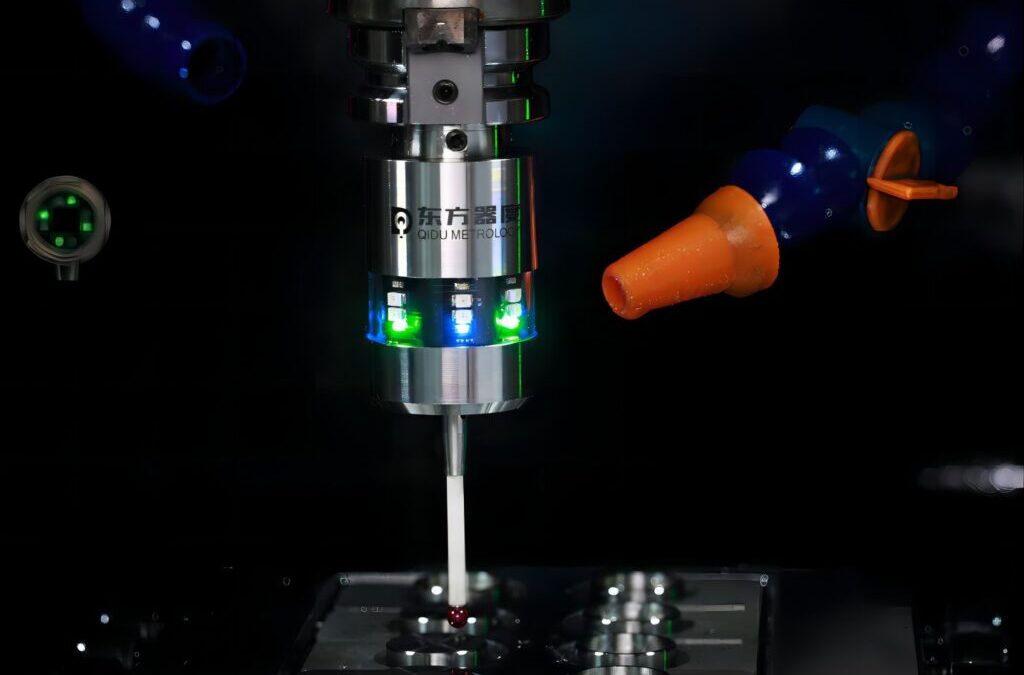
In today’s era of high-precision manufacturing, automated CNC calibration has become essential for maintaining accuracy, consistency, and efficiency across every machining operation. As production demands shift toward tighter tolerances, greater part complexity, and faster cycle times, manufacturers can no longer depend solely on manual setup methods or operator intuition. This is where probing systems play a transformative role. Integrated CNC probing solutions—whether spindle probes, tool-setting probes, or in-process measurement systems—enable machines to monitor, adjust, and verify their own performance with remarkable precision. By automating calibration tasks that were once time-consuming and error-prone, probing systems minimize human variability and ensure that every part begins with the correct geometric reference. As industries such as aerospace, medical devices, automotive engineering, and semiconductor manufacturing push the limits of tolerances, the reliability of automated probing is foundational for achieving predictable, repeatable machining outcomes.
Probing systems dramatically enhance machine accuracy through real-time measurement and automated alignment, helping CNC machines maintain proper positioning even as cutting conditions evolve. During machining, machine components experience thermal expansion, axis drift, and gradual wear—all of which can compromise accuracy if left unchecked. Traditional calibration methods required machines to pause while operators conducted manual measurements, often resulting in inaccuracies due to handling errors, misalignment, or misinterpretation. Automated probing, however, enables CNC machines to detect offsets, geometric deviations, and thermal variation directly at the spindle. By continuously referencing fixed datum points and adjusting work coordinates on the fly, probing systems keep the machine “self-aware” and calibrated. This ensures that toolpaths reflect true machine conditions rather than theoretical values. As a result, manufacturers reduce scrap rates, stabilize quality, and ensure every machining cycle starts from a verified and corrected reference frame.
Another critical advantage of probing systems in automated CNC calibration is their ability to streamline setup and reduce downtime, especially in high-mix, low-volume production environments. Setting up each new job manually—aligning fixtures, locating datums, measuring workpieces—can consume a significant portion of machining time. Probing systems eliminate much of this bottleneck by automatically identifying part position, orientation, and critical geometry. Through predefined macros and probing cycles, the CNC takes measurements and automatically updates work coordinate systems, eliminating guesswork and manual adjustments. For complex 5-axis machining applications, probing ensures accurate rotational centerline calibration, enabling smooth transitions between coordinated axes. This level of automation significantly accelerates job changeovers while reducing operator workload. Even in large production batches, automated probing ensures consistent setup conditions across shifts, production days, and operator experience levels.
Probing systems also improve tool accuracy by verifying tool length, diameter, wear, and breakage directly inside the machine. In high-speed or multi-resource machining operations, tool condition directly impacts the accuracy and quality of the finished part. A tool that has worn only a few microns can alter a component’s geometry enough to cause tolerance deviations. Tool-setting probes allow the CNC to measure tools before, during, and after cutting to ensure that the tool parameters match the programmed values. If deviations are detected—such as gradual wear, unexpected breakage, or thermal expansion—the machine can compensate automatically or pause the cycle to alert the operator. This prevents catastrophic failures, reduces scrap, and extends tool life by optimizing tool usage. When combined with in-process probing of the workpiece, CNC machines gain a closed-loop production environment where every machining step is validated and corrected in real time. This is essential for precision industries where even minor tool inaccuracies can lead to significant quality problems or regulatory non-compliance.
Quality assurance receives a major boost as well, thanks to the integration of probing systems into automated calibration workflows. On-machine probing enables immediate verification of critical features, eliminating the need to transfer parts to external inspection machines for preliminary measurements. While full dimensional inspection may still require coordinate measuring machines (CMMs), automated probing allows manufacturers to validate key features during the machining process, catching potential errors while the part is still fixtured. This in-process inspection reduces rework and ensures that deviations are corrected early, preventing downstream quality problems. Furthermore, probing systems help validate machine performance across long production runs. Regularly scheduled calibration cycles—run automatically via probing routines—ensure that the CNC machine maintains its accuracy over time. This combination of continuous monitoring and automated feedback loops helps maintain statistical process control while reducing the reliance on external metrology tools.
As CNC technology becomes increasingly automated, probing systems are evolving to support smart manufacturing environments, Industry 4.0 frameworks, and closed-loop digital machining ecosystems. Modern probing systems are now capable of integrating directly with adaptive machining software, which analyzes measurement data and automatically modifies toolpaths to correct deviations. This level of responsiveness transforms CNC machines into intelligent manufacturing systems capable of self-correction. Additionally, sensors embedded within probing systems offer advanced capabilities such as multi-axis measurement, non-contact optical scanning, micro-level resolution, and high-speed data collection. These features enable sophisticated calibration that extends beyond simple work offsets to include machine geometry compensation, spindle thermal mapping, and fixture deformation analysis. As new materials, tighter tolerances, and more complex components continue to emerge in modern manufacturing, probing systems will remain one of the most indispensable tools for achieving peak performance, long-term stability, and fully automated precision.
In the future, probing systems will continue shaping the evolution of CNC calibration, enabling machines to think, measure, and compensate with minimal operator involvement. By bridging the gap between machining, measurement, and automated feedback, probing systems provide manufacturers with the tools needed to achieve unparalleled accuracy and stability in even the most demanding applications. Whether for prototype machining, high-precision aerospace components, medical-grade implants, or mass-produced automotive parts, the integration of probing technology ensures that every CNC machine operates at its highest potential. Ultimately, probing systems represent far more than a measurement tool—they are the guiding intelligence behind modern automated calibration, ensuring every machining operation is accurate, stable, and optimized from start to finish.